Mountain Star Avon Real Estate: What the Acreage Numbers Actually Buy You
September 24, 2026
September 24, 2026
Every description of Mountain Star repeats the same figure, and repeats it because it sounds extraordinary: ninety homesites spread across roughly 1,300 acres above Avon, which works out to about fourteen acres per home. It is the kind of number a buyer remembers on the drive up the mountain, and it is the kind of number that quietly falls apart the moment you look at what is actually on a title report.
The homes selling in Mountain Star right now sit on lots closer to two to eight and a half acres. That gap between the marketed average and the deeded reality is not a rounding error. It is the whole story of what this neighborhood is actually selling, and it matters for anyone comparing it against Bachelor Gulch, Beaver Creek, or any other Vail Valley enclave where the price per acre is supposed to mean something specific.
The division itself is simple. Take the 1,300 acres cited across multiple brokerage descriptions of the development, divide by the 90 homesites, and you land on roughly 14 acres per home. It is a true statement about the community as a whole. It is not a true statement about what any single buyer will own.
Multiple sources on the ground put individual lots at a much smaller number: some describe homesites averaging five to ten acres, others put most homes on two to eight acres, and current listings back that second figure. The reason the two numbers diverge is not inconsistency. It is that more than half of Mountain Star's total footprint is preserved as shared open space rather than divided among the 90 deeds.
| Metric | Figure |
|---|---|
| Total development footprint | Roughly 1,300 acres |
| Homesites | 90 |
| Marketed average acreage per home | Roughly 14 acres |
| Share of total acreage kept as shared open space | More than half |
| Typical deeded lot size in current listings | Roughly 2 to 8.5 acres |
| Elevation range | 8,200 to 9,200 feet |
That open space is real and it is part of the value, but it belongs to the community's covenant structure, not to any individual title. A buyer running the math on "acreage per dollar" against a Bachelor Gulch or Beaver Creek comparison is comparing a private, buildable number against a communal average that includes land nobody can fence, build on, or exclude a neighbor from crossing.
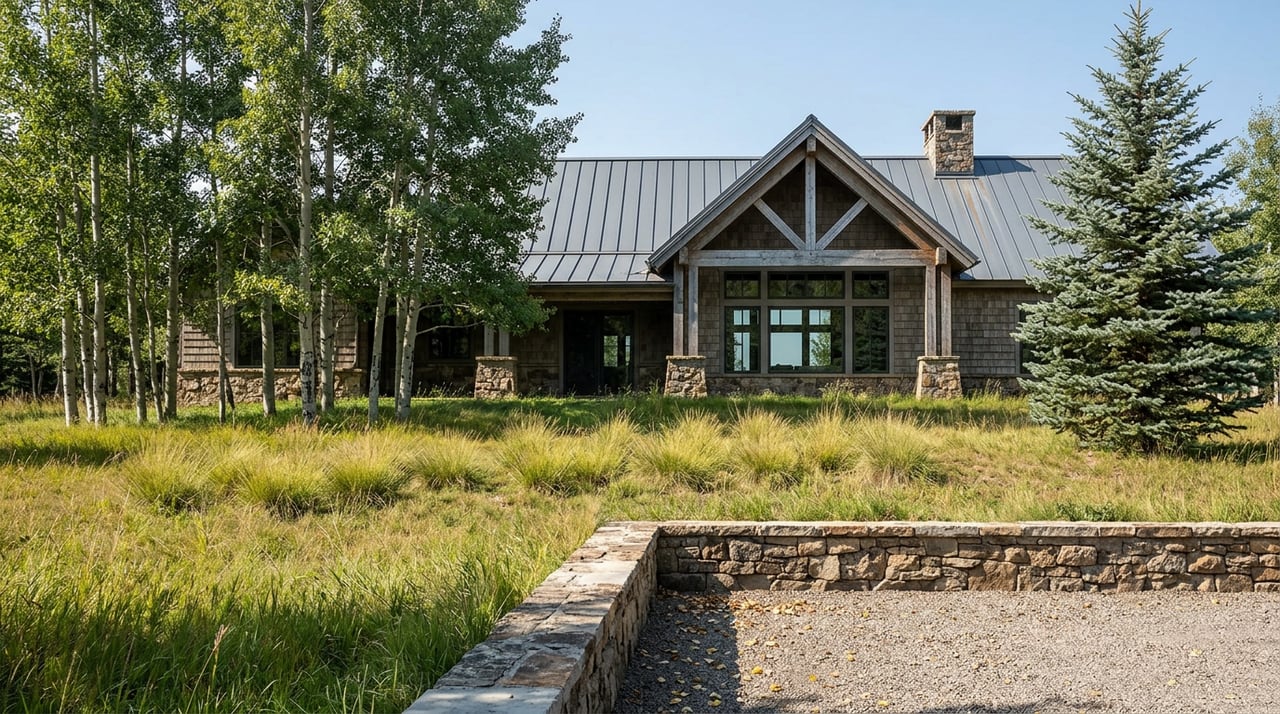
The land that doesn't show up on your deed is doing real work. Mountain Star borders White River National Forest, and the aspen groves, meadows, and forested buffers that separate homesites from each other are what make the neighborhood feel emptier than its lot sizes alone would suggest. Elevations run from 8,200 to 9,200 feet, high enough that I-70's noise disappears entirely, and views open across Beaver Creek Resort, Bachelor Gulch, and the Gore and Sawatch mountain ranges without another rooftop in the frame.
The community's only shared amenity is a small building called Ranch Central, staffed by an on-site caretaker who handles maintenance and owner services and doubles as a gathering space for residents. There is no restaurant, no clubhouse bar, no retail. Architectural review boards and recorded covenants govern what gets built, which is standard for a large-scale development managing dozens of individual custom homes, but it also means the open space you are paying into is protected by contract, not by goodwill.
So the fourteen-acre figure is not wrong. It is just describing a different asset than the one you close on. You are buying two to eight and a half private acres, plus a contractual interest in a buffer that will never be developed. For a buyer trying to model resale value or compare price per acre against a neighborhood with smaller, denser lots, that distinction changes the comparison entirely.
Here is where the comparison to other Avon-area luxury inventory gets more interesting, and more relevant if you're weighing Mountain Star against a ski-in property built for income as well as lifestyle.
The Town of Avon regulates short-term rentals through a defined Short-Term Rental Overlay District, and properties outside the Town Core but inside that overlay face a cap: no more than 15 percent of dwelling units in a given development can hold an STR-Full license. That cap is not automatic just because a property is luxury or new. When The Kestrel, a 24-unit townhome development on Eaglebend Drive, wanted to offer nightly rentals, it had to formally apply for inclusion in the overlay district, a process the town council debated openly at a 2025 meeting before approving it.
Mountain Star has never been positioned or discussed as part of that conversation. Brokerage descriptions of the neighborhood consistently use a phrase you don't see applied to Beaver Creek or Bachelor Gulch inventory: purely residential. That is not a marketing flourish. It signals that the rental income assumptions a buyer might build into a Bachelor Gulch or Beaver Creek purchase model do not carry over to a Mountain Star purchase.
Avon's own town manager, Eric Heil, put the underlying math plainly during that same council discussion, speaking about carrying costs on the town's higher-end inventory generally:
"At $2.5 to 5 million, the cheap units you're starting out at a $15,000 a month mortgage payment. If you don't allow short-term rental, they're not going to be available to local workforces the way I see those economics."
That comment was made about Avon's broader luxury stock, not Mountain Star specifically, but the arithmetic applies directly. A $6 to $9 million Mountain Star home, priced in line with current listings in the neighborhood, carries a mortgage payment on that same order of magnitude with no STR income to offset it. If your spreadsheet for a Beaver Creek or Bachelor Gulch purchase assumes rental weeks will cover part of the carry, that same spreadsheet does not work for Mountain Star. It was never built to.
Put the two findings together and the picture sharpens. Mountain Star's fourteen-acre average is a community-wide figure inflated by preserved open space, not a private lot size. And the neighborhood's "purely residential" positioning means the price you pay isn't offset by rental income the way a comparably priced Beaver Creek or Bachelor Gulch property might be.
What you are buying instead is a specific, verifiable combination: two to eight and a half private acres, elevation above 8,200 feet, unobstructed sightlines to the Gore and Sawatch ranges, a covenant-controlled architectural standard that protects those sightlines for the life of the community, and an on-site caretaker at Ranch Central rather than a front desk. For a buyer whose priority is quiet and permanence over yield, that is precisely the trade worth making. For a buyer modeling this as an income property alongside a ski-in unit, the numbers point somewhere else.
Is the acreage figure I'm seeing the lot size or the community average? Ask for the plat map on any specific listing rather than relying on the neighborhood-wide figure. The difference between 14 acres and the actual 2 to 8.5 acre range on a given parcel is significant enough to affect how you value the property against alternatives.
Does this property fall inside Avon's Short-Term Rental Overlay District? Most Mountain Star parcels do not function as rental income properties, and the neighborhood's covenants and positioning reflect that. Confirm the zoning and any recorded restrictions directly rather than assuming a nightly-rental use case will be available.
What is actually covered by the shared open space, and what does the architectural review process require? The covenant structure that preserves the buffer between homes is also the same structure that will govern anything you eventually build or modify. Reviewing it before you tour saves a conversation later.
Mountain Star rewards a buyer who wants privacy and permanence more than upside, and there is nothing wrong with wanting that. It just needs to be the thing you're actually buying, not the thing the marketing average implied. If you're weighing this neighborhood against Beaver Creek, Bachelor Gulch, or another Vail Valley enclave and want the acreage, covenant, and carrying-cost math run side by side for your specific situation, A.K. Schleusner can walk the comparison with you. Schedule a private showing and we'll start with the deed, not the brochure.


One of A.K.'s biggest strengths is her creativity in getting a deal done! A.K.'s clients are considered friends, and she enjoys getting together with them on and off the hill.