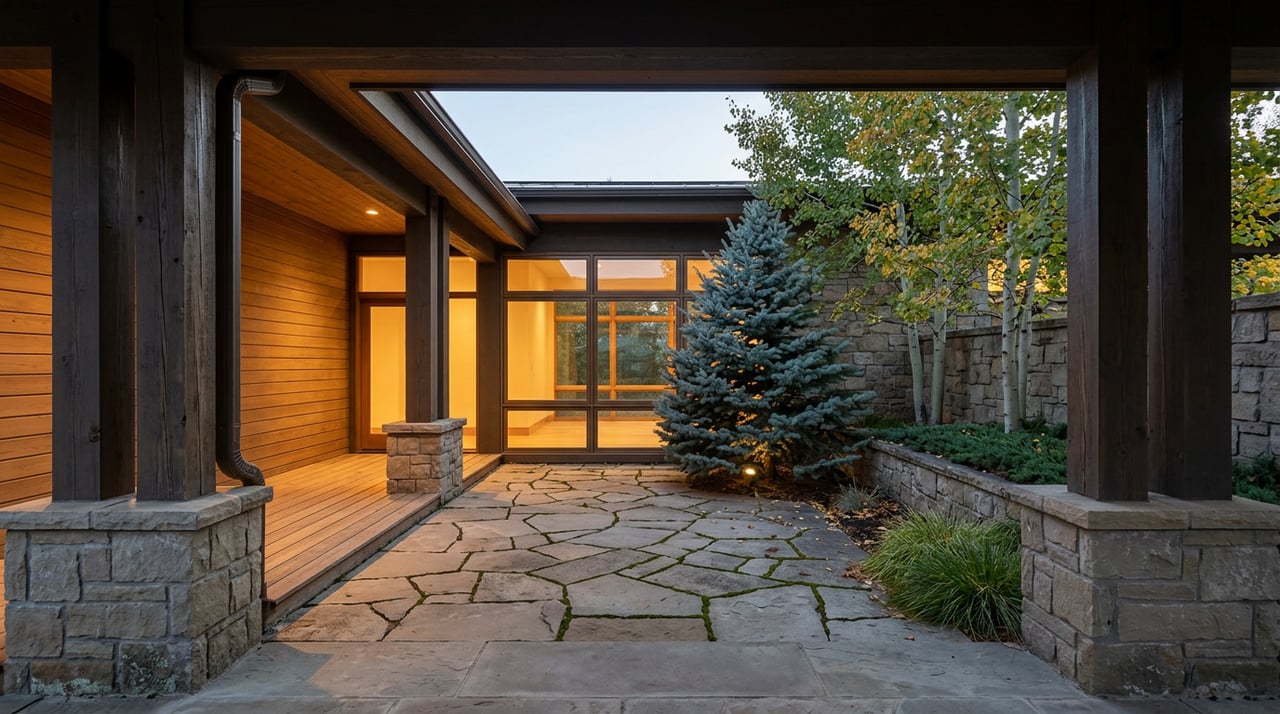
The One Percent Tax That's Quietly Changing Who Bids on Your Vail Listing
September 17, 2026
September 17, 2026
Every closing in the Town of Vail carries a 1 percent transfer tax, and if you've priced a home here before, you already know the arithmetic: a $1.5 million sale means $15,000 changes hands at the table, usually paid by the seller unless the contract says otherwise. That much is settled and easy to find. What most explanations stop short of is the part that actually matters if you're selling anything under $1.25 million right now: the same ordinance that created that tax also created an exemption, and this spring the town turned that exemption into real cash for a specific kind of buyer. That buyer is now showing up in the offer pile, and understanding what they're offering, and what they're asking for in return, changes how you should read every bid you get.
Vail's Real Estate Transfer Tax has been capped at 1 percent since 1987, when the town's own Cap & Tabor Amendment set the ceiling and the state's TABOR Amendment later made it permanent by prohibiting the town from raising it without a public vote. The revenue is earmarked for land: acquisition, improvement, and maintenance of parks, recreation space, and open land within town limits and up to a mile beyond it, a use that dates back to a 1992 ordinance that funded the Dowd Junction recreation path. If you've sold a $2 million home here, you've written a $20,000 check to that fund, and it shows up on the closing statement as a single line most buyers and sellers just accept and move past.
That's the version every closing guide already tells you. The version worth your attention is the one Vail's own housing office publishes on a completely different page: deed-restricted units are exempt from that tax entirely, provided the buyer or seller applies for the exemption before closing. On paper that reads like a technical carve-out for affordable housing transactions. In practice, as of this year, it's become a lever the town is actively pulling to reshape which homes in your price range even reach the open market.
On April 8, 2026, the Eagle County Housing and Development Authority and the Town of Vail announced Good Deeds Vail, a new matched buy-down program built on the same model that's already run in Avon. The mechanics are specific and worth knowing exactly as written: the town and the county will each contribute up to 15 percent of a home's purchase price, a combined buy-down of up to 30 percent capped at $375,000, in exchange for recording a permanent, price-capped deed restriction on the property. The program applies to open-market homes not already deed-restricted, inside Vail's town boundaries, priced at $1,250,000 or less, where the buyer will occupy the home as a primary residence and bring at least 3 percent of the purchase price themselves. For homes priced at $850,000 or under, the buy-down also stacks with Eagle County Loan Fund's Down Payment Assistance program. The Valley Home Store administers it.
Jason Dietz, the Town of Vail's Housing Director, described the arithmetic behind the decision when the program launched:
"This partnership cuts the town's subsidy in half by splitting costs with the county, with both the town and county as beneficiaries to the deed restriction."
That single sentence explains why this program scales in a way earlier efforts didn't. Vail InDEED, the town's original deed-restriction purchase program launched in 2018, worked by paying homeowners directly to accept a restriction, funded entirely out of the town's general fund. It's been effective enough that the town already counts nearly 1,040 deed-restricted homes toward its 2027 goal of 1,000, hitting the target roughly a year ahead of schedule. But every dollar of that came from Vail alone. Good Deeds Vail halves the town's exposure per unit by bringing the county in as an equal partner, which means the same budget now buys twice the restrictions. Kim Bell Williams, Executive Director for Housing Eagle County, put a number on what that partnership model has already produced across the valley:
"The Good Deeds program has made a true difference for local housing in Eagle County with over 200 units added in the last 5 years."
Here's the part that changes how you should think about a listing, not just a closing statement. A Good Deeds Vail buyer isn't a weaker offer. They're arriving with up to $375,000 in matched public funds behind them, a 3 percent down payment requirement that's lower than most conventional loans, and a closing that qualifies for the RETT exemption the moment the deed restriction is recorded. If you're selling a $1.1 million home in Vail this fall, that buyer can compete on price with a conventional second-home buyer while asking you to accept a deed restriction as part of the deal, and the tax savings alone is worth roughly $11,000 to whoever the contract assigns it to.
What you're trading for that certainty is worth spelling out plainly, because it's exactly what the program is designed to lock in. Once a home carries a deed restriction, future resale price and appreciation are both capped, and the buyer pool for the next sale is limited to residents who work at least 30 hours a week for an Eagle County business. The town's own Chamonix Vail development shows what that looks like in real numbers. Earlier this year, when the town ran its lottery for a three-bedroom, three-bath Chamonix Vail townhome, the maximum resale price was set at $625,350, with future appreciation capped at 1.5 percent per year plus the cost of any approved capital improvements. That's not a penalty built into a bad program. It's the mechanism that keeps the home affordable for the next qualified buyer in perpetuity, and it's precisely what makes the up-front buy-down possible in the first place.
For a seller weighing an offer, the comparison looks something like this:
| Conventional Sale | Good Deeds Vail Sale | |
|---|---|---|
| Transfer tax owed | 1% of price, per contract terms | Exempt with approved application |
| Buyer's minimum down payment | Typically 10-20%+ | 3% |
| Future resale price | Set by open market | Capped, tied to program formula |
| Buyer eligibility for next sale | Any qualified buyer | Must work 30+ hrs/week in Eagle County |
| Occupancy requirement | None | Primary residence required |
Neither column is the right answer for every seller. A restriction that removes future appreciation matters more to someone who sees the property as a long-term asset than to someone who needs a clean, fast, well-financed close this year. The point is that this is now a real decision with real numbers attached, not a hypothetical you can defer until an offer forces the question.
If you're shopping in that same sub-$1.25 million range, whether it's an entry point into Vail proper or an investment condo you plan to occupy part of the year, it's worth knowing you may be bidding against a bidder pool you can't outbid on terms alone. A Good Deeds Vail buyer's financing is structurally different from yours, and if a seller is weighing your all-cash offer against a subsidized buyer who's also offering to solve a housing problem the town has been chasing since 2018, price isn't the only variable in play. Knowing that going in changes how you write the offer, and how much flexibility you build into your terms beyond the number on the contract.
Does the transfer tax apply if I'm the one adding a deed restriction through Vail InDEED? No. Once a unit carries an approved deed restriction, the sale is exempt from the town's 1 percent transfer tax, though the buyer or seller still has to apply for that exemption before closing.
Does a deed restriction change what I owe in property taxes? No. The exemption applies to the transfer tax at the point of sale. Property taxes continue as they would on any other home in Vail.
Is Good Deeds Vail the only path to a deed-restricted sale, or does Vail InDEED still exist separately? Both programs run at the same time. Vail InDEED pays homeowners directly, funded by the town alone, with no household size requirement and no cap on how many properties one person can restrict. Good Deeds Vail is narrower and newer, aimed specifically at buyers purchasing an open-market home under $1.25 million who'll occupy it as their primary residence, with the town and county splitting the cost.
The tax was never really the story. What it's exempting, and who the town is now paying to claim that exemption, is. If you're weighing a sale or a purchase anywhere near that $1.25 million line in Vail this year, that's the conversation worth having before you set a number.
If you'd like to talk through what this means for a specific address or a specific offer, A.K. Schleusner is glad to walk through the numbers with you. Schedule a private showing and we'll bring the closing math along with the keys.


One of A.K.'s biggest strengths is her creativity in getting a deal done! A.K.'s clients are considered friends, and she enjoys getting together with them on and off the hill.